
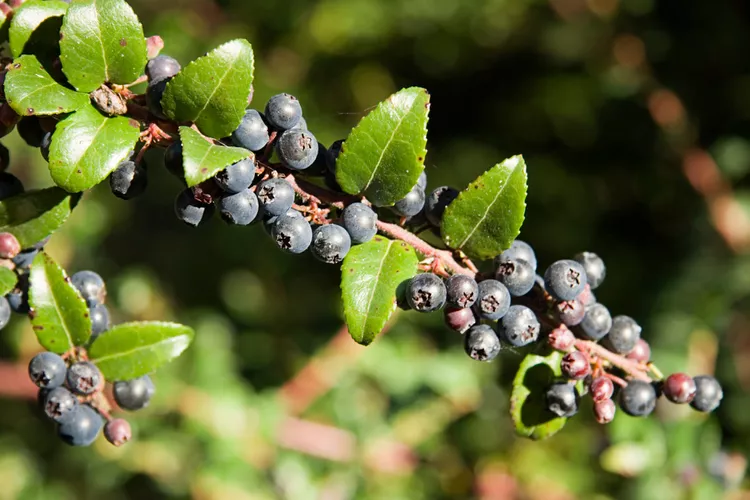
Huckleberry is a native shrub in the heath family, closely related to blueberries and cranberries. There are two main types of huckleberry bushes. Huckleberries in the Gaylussacia group, or genus, grow wild in the forest underbrush in eastern North America and Canada. Their small flowers in the spring turn into smooth, dark blue or purple-black berries held in clusters, similar to blueberries. The other group, Western huckleberries, is in the Vaccinium genus. Depending on the species, these shrubs grow along the Pacific Coast from central California into southeastern Alaska and have red, blue, black, or purple berries. The fruit ranges from mildly sweet to tart.
Huckleberries are hardy shrubs that grow between 3 and 10 feet. They don't need much care once established.
Where to Plant Huckleberry
Huckleberry bushes grow in dappled light and partial shade but to produce fruit, they need full sun. The soil must be well-drained and acidic soil and contain lots of organic matter.
Use these shrubs as an understory plant in a woodland area, on slopes to stabilize the soil, or in a naturalized area where you want to attract wildlife.
How and When to Plant Huckleberry
Finding huckleberries at nurseries can be tricky. Your best bet is to seek out businesses or organizations that specialize in native plants. Also, check out the International Huckleberry Association, which lists nurseries that sell huckleberry plants on its website. or search online. Choose a variety recommended for your hardiness zone.
Plant nursery-grown huckleberry plants in the spring after the last frost. Dig a hole at least twice the size of the root ball and just as deep. Place the plant in the center of the hole and gently spread out the roots. Backfill with the original soil so that the top of the root ball is flush with the soil. Tamp down the soil and water it well. Add a generous amount of mulch around the base of the plant to retain moisture and water deeply and regularly.
Space plants 3 to 4 feet apart.
Huckleberry Care Tips
Light
For the best fruit production, huckleberries need at least 6 hours of full sun every day. While they grow in shady conditions, less sun means fewer berries.
Soil and Water
Huckleberries require well-drained, acidic soil with a pH between 4.3 and 5.2. Before planting huckleberries, it is essential that you test your soil pH and lower the pH if needed.
Consistent moisture is also key. Water the plants regularly in the absence of abundant rain.
Temperature and Humidity
Huckleberry plants are very winter-hardy and withstand temperatures below freezing. They need cold winter temperatures to successfully bloom and fruit in the spring.
Fertilizer
If they are grown in rich, fertile soil, huckleberries do not need much fertilizer. At the most, feed them once in late spring with a complete balanced slow-release granular fertilizer such as 10-10-0. Do not fertilize after early summer, as it leads to lots of new growth that is vulnerable to winter cold.
Pruning
Huckleberry bushes are slow-growing and don't need much pruning. In late winter and early spring, remove dead and diseased branches as well as branches that are crossing or rubbing against each other.
Always weed by hand around huckleberries. The plants have shallow roots that are easily damaged.
Potting and Repotting
Huckleberries are not suitable to be grown in containers. In a pot, not matter its size, the shallow roots dry out fast. In the winter, the roots are not sufficiently insulated against the cold, despite the plant's hardiness.
Pests and Problems
Pests and diseases usually leave huckleberries alone. Spider mites, aphids, and mealybugs may appear, but don't usually cause serious problems. Knock them off your huckleberry bushes with a stream of water from your hose, pick them off by hand, or use neem oil.
Deer like to browse the shrubs. The berries are a staple for rabbits and other small animals as well as birds so you will be competing against wildlife. Consider erecting a fence so you'll get to harvest the berries.
How to Propagate Huckleberry
Huckleberry bushes are propagated by division, seed, or cuttings. Divisions are the quickest path to mature fruiting plants. Seeds and cuttings fruit in three to five years and it usually takes them a decade or more to bear heavily.
Division: Growing huckleberries by division is easy. The bushes spread by underground stems, so they don't have a central root system. In late fall or early winter, dig up a root clump big enough to fill a 3 to 5-gallon bucket. Next, backfill the container with potting soil. Water thoroughly and leave the plant in the container for one to two years, so it has time to recover. When you're ready to plant it in the ground, dig a hole twice the size of the root ball, mix in lots of organic matter, and backfill the hole. Water thoroughly and apply a layer of mulch around your plant.
Seed: Soak seeds for 24 hours to soften them, then sow them indoors four to six weeks before your last spring frost. Cover them 1/4 inch deep and keep them moist until they germinate in about two weeks. Give the seedlings at least 5 hours of direct sun a day. Pot them up when they're 2 inches tall and move your plants into the garden in early summer.
Cuttings: Take 4-inch cuttings in late winter to early spring. Bury them in flats of damp sand and cover them with clear plastic. When their roots are 2 inches long, move them into one-gallon pots filled with potting soil. Plant them in the garden when they're 6 inches tall, spacing them 3 feet apart.
Harvesting Huckleberries
It takes huckleberry bushes three to four years to start producing berries and you can expect a full harvest in five or six years after planting.
Huckleberries ripen between August and September. The berries are ready to be picked when they are dark blue or purple and easily come off the plant.
Types of Huckleberry
Mountain Huckleberry
Mountain huckleberry (Vaccinium membranaceum), also known as mountain bilberry, globe huckleberry, thin-leaf huckleberry, and Montana huckleberry, produces berries that are red, blue, purple, black, and even white, with good to excellent flavor. This is the most widely harvested western huckleberry and Idaho’s state fruit. The bushes are 1 to 4 feet tall. Zone 5–9
Black Huckleberry
Black huckleberry (Gaylussacia baccata) grows 3 feet tall and 4 to 5 feet wide and forms dense thickets. This huckleberry is the most valuable when planted in a woodland setting where its blue-black berries serve as a food source for wildlife. It is also useful to prevent erosion on slopes. The leaves turn orange and scarlet in the fall. Zone 3–7
Evergreen Huckleberry
Evergreen huckleberry (Vaccinium ovatum), also known as box huckleberry, is an Oregon native that has a large distribution range on the Pacific Coast from northern California to British Columbia. This neat, upright plant grows to 8 feet tall and produces blue-black berries in late summer. Zone 3– 7